A free community resource from Global Strawberry. This page is general information only — it is not medical advice and does not replace certified first-aid training or professional emergency care. In an emergency in Canada or the US, call 911 immediately.
Demonstration videos are for general awareness only — certified training is the only way to learn these skills safely.
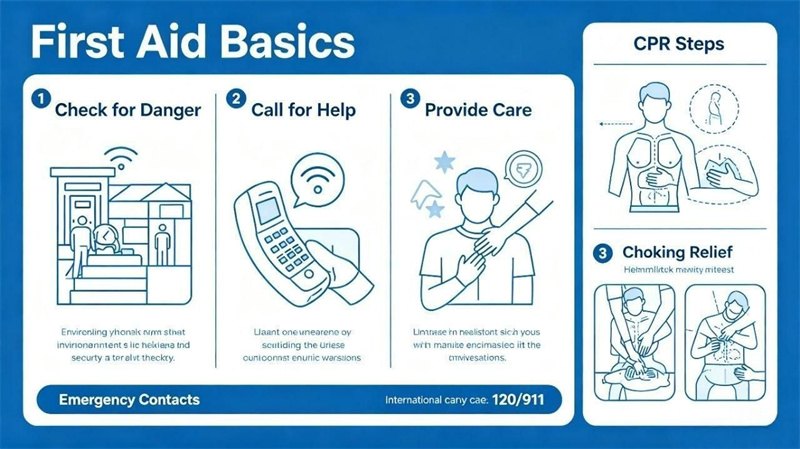
1. Check for danger. Before helping anyone, make sure the scene is safe for you — traffic, fire, electricity, water. A second casualty helps no one.
2. Call for help. Call 911 (Canada/US) or your local emergency number. Say where you are, what happened and how many people are hurt, and stay on the line — the dispatcher will guide you.
3. Provide care. Only within what you know. Keep the person still and warm, and keep talking to them until help arrives.
Call 911 first (or have someone else call). Place the heel of one hand in the centre of the chest, the other hand on top, arms straight. Push hard and fast — about 5 cm deep, 100–120 compressions per minute. Do not stop until paramedics arrive or the person responds. Hands-only CPR is effective and recommended for untrained helpers.
Give 5 firm back blows between the shoulder blades with the heel of your hand. If that fails, give 5 abdominal thrusts: stand behind them, place a fist just above the navel, grasp it with the other hand, and pull sharply inward and upward. Alternate 5 and 5 until the object comes out. If they lose consciousness, start CPR and make sure 911 has been called.
Press hard on the wound with a clean cloth and do not let go. If blood soaks through, add more cloth on top and keep pressing. Call 911 for bleeding that spurts, will not stop, or soaks through dressings.
Cool the burn under cool running water for 10–20 minutes. Remove rings and watches near the area before it swells. Do not apply ice, butter or creams. Cover loosely with a clean non-stick dressing. Seek medical care for burns that are large, deep, on the face or hands, or caused by chemicals or electricity.
A one-day certified course teaches far more than any web page. In Canada, courses are offered by the Canadian Red Cross and St. John Ambulance.
General information checked against publicly available Red Cross guidance. When in doubt, call 911.
 Global Strawberry